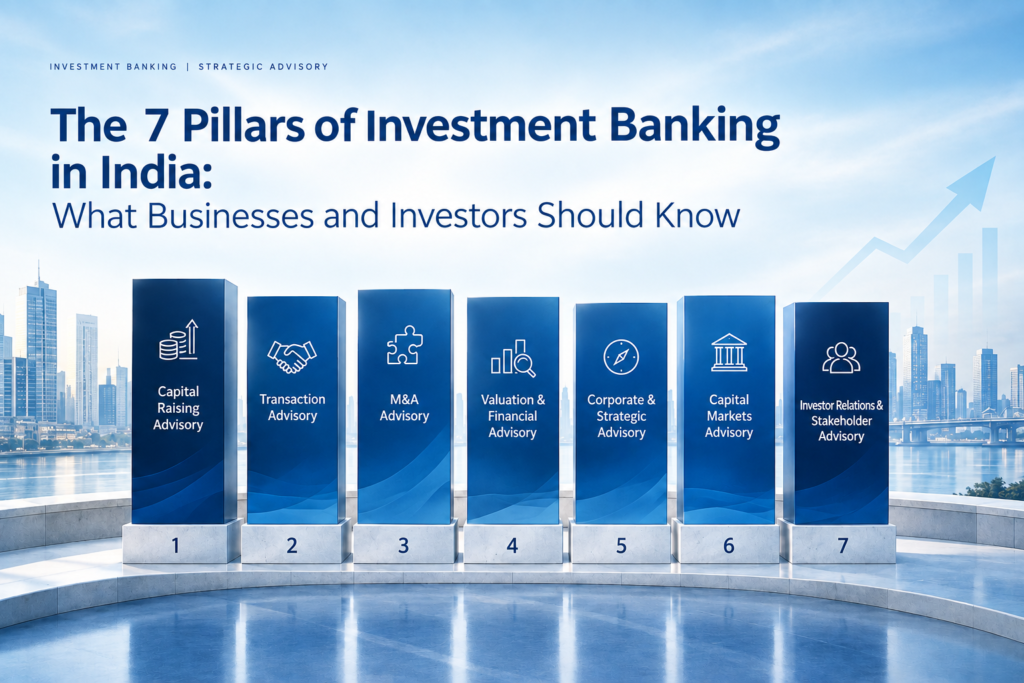
The 7 Pillars of Investment Banking in India:
A Guide for Businesses and Investors
Investment banking in India has evolved beyond simply connecting businesses with capital. As companies scale, pursue acquisitions, restructure finances or prepare for public and private markets, they require financial expertise that combines capital strategy, valuation, transaction execution and strategic advisory.
The investment banking ecosystem can broadly be understood through seven interconnected pillars, each supporting businesses and investors at different stages of the financial journey.
1. Capital Raising Advisory
Capital is an important growth enabler, but raising capital is not simply about finding an investor. Capital Raising Advisory helps companies evaluate financing options including equity, debt, venture capital, private equity, structured finance, and IPO or pre-IPO opportunities.
The objective is to identify a financing structure aligned with the company’s financial position, growth plans and long-term objectives. This includes preparing the investment proposition, identifying appropriate capital partners and determining a suitable capital structure. For businesses, the right capital should support growth without creating unnecessary financial or strategic constraints.
2. Transaction Advisory
A successful transaction requires considerably more than reaching an agreement on valuation. Transaction Advisory supports businesses and investors throughout the deal lifecycle through buy-side and sell-side advisory, deal structuring, due diligence support, transaction execution and negotiation.
It helps stakeholders evaluate opportunities, understand financial and transaction risks and address potential issues before capital is committed.
For investors, this can improve decision-making. For businesses, stronger transaction preparation can reduce execution challenges and improve deal readiness.
3. Mergers & Acquisitions Advisory
M&A can help businesses accelerate growth, enter new markets, acquire capabilities, consolidate market positions or create liquidity for shareholders.
M&A Advisory covers acquisitions, strategic mergers, business sales, joint ventures and cross-border transactions.
However, identifying a buyer, seller or target is only one part of the process. Successful M&A requires understanding strategic fit, establishing valuation expectations, negotiating transaction structures and managing execution. The real question is not simply whether a transaction can be completed, but whether it creates sustainable strategic value.
4. Valuation & Financial Advisory
Whether raising capital, acquiring a company or evaluating an exit, stakeholders need a credible understanding of value.
Valuation & Financial Advisory includes business and startup valuations, fairness opinions, financial modelling, scenario analysis and sensitivity analysis.
Effective valuation goes beyond applying a multiple. It considers financial performance, assumptions, future growth potential and risks surrounding the business.
For investors, valuation supports disciplined capital allocation. For companies, it provides an important foundation for negotiations and strategic financial decisions.
5. Corporate & Strategic Advisory
Not every important financial decision involves an immediate transaction. Corporate & Strategic Advisory helps management teams evaluate areas including growth strategy, capital structure, restructuring, strategic planning and exit strategy.
For example, should growth be financed through equity or debt? Should the company acquire capabilities or build them internally? Should shareholders prepare for an eventual strategic sale?Connecting financial decisions with broader business objectives helps leadership teams make choices that support long-term value creation.
6. Capital Markets Advisory
As companies mature, public markets can become an important source of capital and liquidity. Capital Markets Advisory supports companies considering IPOs, rights issues, Qualified Institutional Placements (QIPs), preferential issues, listings and related regulatory requirements.
Public-market transactions require businesses to operate with greater financial discipline, governance and stakeholder transparency. Therefore, preparation often begins well before the actual transaction. Companies need to understand whether their financial reporting, business positioning, governance and capital strategy are ready for public-market scrutiny.

7. Investor Relations & Stakeholder Advisory
Completing a fundraise or transaction does not end a company’s relationship with investors.
Investor Relations & Stakeholder Advisory focuses on maintaining effective communication through investment memorandums, pitch decks, investor reporting, investor communication strategies, and board and stakeholder presentations.
Strong communication allows stakeholders to understand business performance, strategic priorities and future direction.
Importantly, investor communication should not simply present information, it should communicate the company’s investment proposition clearly, consistently and credibly.
How the Seven Pillars Work Together
These pillars rarely operate independently. A growing company may initially require capital raising and valuation support. As it scales, it may explore an acquisition, restructure its capital, introduce secondary liquidity or eventually prepare for a strategic exit or public-market transaction.
This is where an integrated investment banking approach becomes valuable.
At Equity360, our advisory capabilities span Private Capital Advisory, M&A, Transaction Advisory, Private Credit & Debt Advisory, Secondary & Liquidity Solutions, and Valuation & Fairness Opinions.
The objective is to help businesses and investors navigate important capital and transaction decisions with greater clarity and strategic alignment.